


Bilona, A2 and Organic Ghee: What Each Label Means
Bilona describes a process, A2 concerns milk sourcing, and organic is a separate certification claim. Use this guide to ask clearer questions before buying.
Bilona, A2 and organic describe different things: a production route, a milk-sourcing claim and an organic-production claim respectively. None of these words proves the other two. Read each statement separately and ask for the evidence that relates to that particular claim.
A jar can carry several attractive words, but a long label is not necessarily a clear label. Understanding the distinctions helps you compare products without relying on a brand name, a rural photograph or a premium price. It also gives the traditional bilona process its proper meaning.
Bilona: ask what was churned
In the traditional curd-churned route, milk is cultured into curd, the curd is churned to recover butter, and that butter is heated and clarified into ghee. The useful question for a seller is whether the starting material was whole curd, cultured cream or another material.
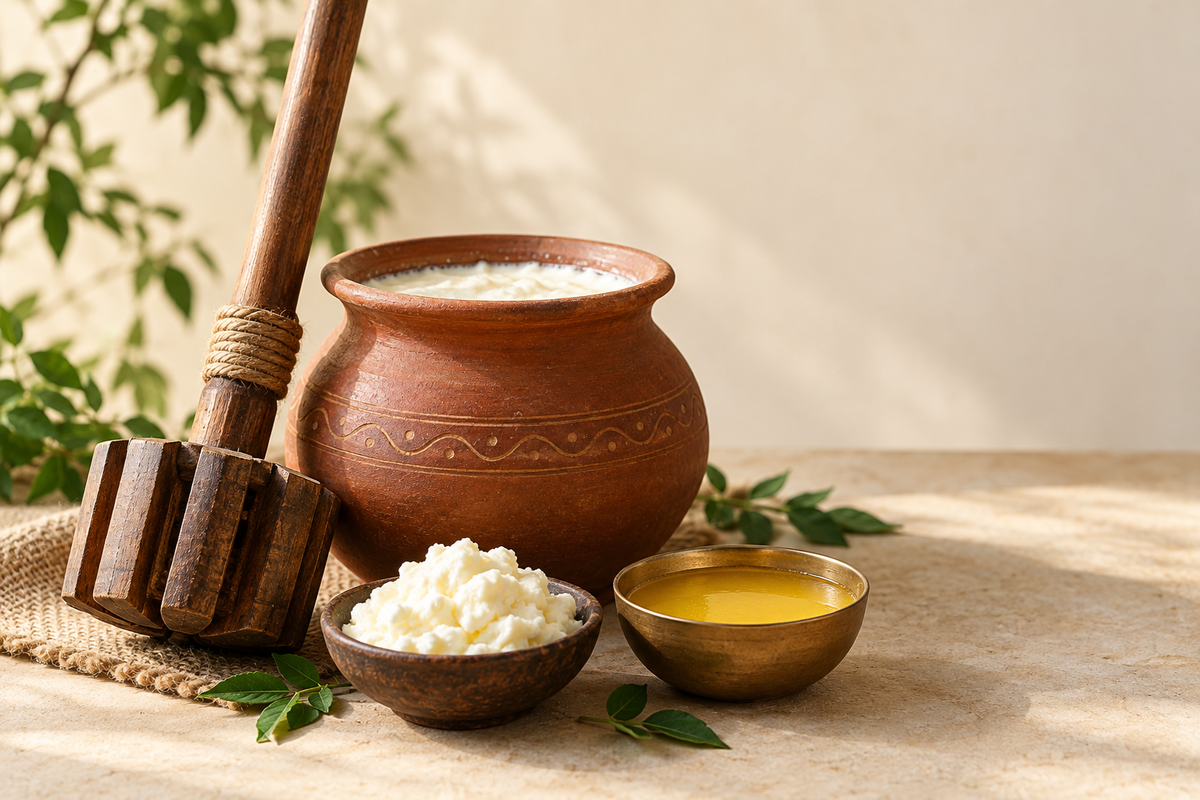
A wooden churn in a photograph does not document the complete production process. Ask the maker to describe the sequence. For the practical steps, see how to make ghee from curd. For a process comparison, read bilona versus the direct-cream method.
A2: keep the milk claim separate
A1 and A2 refer to variants of beta-casein, a milk protein. An A2 ghee description therefore needs to be understood in relation to the milk supply, rather than as the name of a churning technique. The EFSA review of beta-casomorphins provides background on the milk-protein distinction; it is not a certificate for a commercial ghee.
Ask what sourcing records support the description. Do not treat the word “desi,” a cow photograph or a breed name as a complete chain of evidence for an individual jar. Likewise, a traditional process alone does not establish the source of the milk.
Organic: look beyond a name or green label
FSSAI's organic-food guidance distinguishes certification systems and describes information shoppers can inspect on labels, including certification-body or group details. Use the Jaivik Bharat consumer guidance and the relevant certification records to check a claimed organic status.
A brand or product name containing “organic” or a similar word is not, by itself, the evidence you need. Neither are green packaging, a farm illustration or a statement that a product is traditionally made. Check which product and operator a certificate covers and whether the information is current.
Put the claims in separate columns
| Label term | Main question | Useful follow-up |
|---|---|---|
| Bilona | How was the ghee made? | What was cultured and what was churned? |
| A2 | What is claimed about the milk source? | What sourcing records support that claim? |
| Organic | What organic-production status is claimed? | Which certificate and product scope can I verify? |
| Grass-fed | What is claimed about feeding? | How is that term defined and documented by the producer? |
| Lab-tested | What sample and property were tested? | Can I read the relevant report? |
These columns are a buying worksheet, not a ranking. A well-explained answer is more useful than counting how many terms appear on the front of a jar. If you cannot verify a claim, keep it marked as unverified rather than filling the gap with an assumption.
How this applies to Faimly Farm
The current Faimly Farm Organica A2 Cow Ghee Bilona Churned listing describes indigenous-cow milk and a curd-to-butter bilona process. Those are the seller's product descriptions. This guide does not present the product name “Organica” as proof of organic certification, nor does it provide independent verification of sourcing.
Check the product page and the pack you receive, and ask for documentation when certification or testing is important to your purchase. Use our laboratory-report guide to frame questions about testing.
Quick answers
Is bilona ghee always A2?
No. The process and milk source are separate questions.
Is A2 ghee automatically organic?
No. A milk-sourcing claim does not establish organic certification.
Does a higher price prove the label claims?
No. Compare evidence and quantity separately from price. Our pack-price guide explains how to compare grams and millilitres fairly.
Prepared by Faimly Farm with AI assistance, 15 October 2026. Official background sources are linked above. This explainer does not award certification or claim a health advantage.
Continue reading
View all stories
Regional Names for Ghee: Ghrta, Nei and Tuup
A practical guide to Sanskrit ghrta, Tamil nei and Marathi tuup: translate recipe ingredients while keeping quantities, sourcing and process claims sepa...
Read the story
Cow and Buffalo Ghee Blends: What Does the Ratio Describe?
A cow-and-buffalo ghee blend is not automatically 50:50. Learn to distinguish milk, fat and finished-ghee ratios with a practical comparison worksheet.
Read the story
Filtering Homemade Ghee: Tools, Sediment and Careful Handling
Learn how to strain homemade ghee with a stable, dry setup, troubleshoot slow filtering and understand why filtration cannot prove purity or rescue dama...
Read the storyExplore Faimly Farm ghee


Join the conversation