



Choosing a Museum Image for a Ghee Recipe Book: Check the Actual Reuse Terms
An editorial checklist for choosing a museum image, using The Met's published Open Access policy as a specific example.

Check the reuse terms for the exact image before putting it into a ghee recipe book. An old artwork, a downloadable file and a museum webpage are not interchangeable evidence of permission. Start with the object record and the institution's current image policy.
A specific example: The Met's Open Access programme
The Metropolitan Museum of Art's Open Access page describes its release of public-domain artwork images and collection data under Creative Commons Zero, or CC0. This is a named institution's programme; do not assume every museum follows the same terms.
The Met's image-resource FAQ tells readers to look for the Open Access icon on the image. It permits commercial and noncommercial use of images designated OA, without a separate permission request. Images on its website that are not designated OA need a different check.
Keep a record beside the downloaded file
For your project folder, create one entry per selected image:
- The exact object-page URL and accession or object number.
- The image file actually selected, rather than a screenshot from search results.
- The policy or licence attached to that image and the date you checked it.
- The creator, title, date and credit details supplied by the record, preserving uncertainty.
- Your planned use: inside pages, cover, website or promotional material.
- The proposed caption and any crop or other change you intend to make.
This is an editorial record-keeping method, not legal clearance. If the image's status is unclear, leave it out until you have a reliable answer from the relevant rights holder or institution.
Write a caption that does not overclaim
Identify a historical object as a historical object, and a modern dish as a modern dish. Do not place an old painting beside a new recipe in a way that suggests the painting documents that exact recipe, its ingredient quantities or the chosen commercial ghee.
The Met encourages citation even where its OA policy does not require attribution. Its FAQ also prohibits implying museum endorsement and notes that CC0 does not remove other rights such as trademarks or privacy and publicity rights. An open image is not a brand partnership.
Keep today's A2 ingredient on today's recipe page
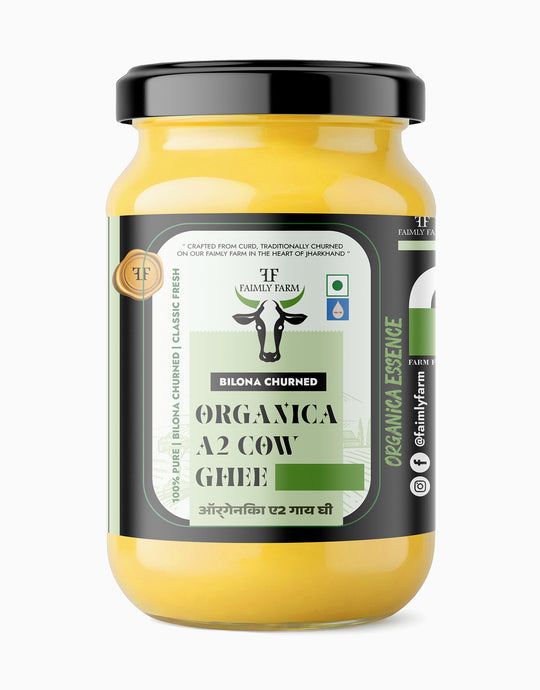
If a new recipe uses Organica A2 Cow Ghee Bilona Churned, identify that as the present-day ingredient selected for the recipe. Do not relabel an unidentified historical ghee as A2 or suggest that an old artwork proves the product's ancestry or health benefits.
A modern illustration can be simpler than a historical image when your aim is to explain the new dish. Label generated imagery honestly. Our banner shows empty frames as a concept; it reproduces no museum artwork.
Quick questions
Does “available online” mean “cleared for my book”?
No. Check the particular image and intended use against its actual terms.
Does permission for a contributor's recipe cover a museum image?
No. Keep separate records for separate material. See our community recipe-book permission guide.
Browse Heritage & Society.
Prepared by Faimly Farm with AI assistance. Sources and catalogue checked 23 October 2026. Banner: AI-generated editorial illustration, not a photograph of a product pack, kitchen test, museum object or historical event. Visit the Faimly Farm Journal.
Continue reading
View all stories
Reading Milk, Curd and Ghee in an 1826 Krishna Drawing Record
A focused reading of a museum catalogue record, showing how to preserve attribution and uncertainty when discussing ghee in heritage.
Read the story
Living Food Heritage: Pass On the Skill Behind a Ghee Recipe
A family recipe archive can support learning as well as storage. Start with one skill someone wants to practise and keep its attribution clear.
Read the story
Operation Flood and Butter Oil: Reading India's Dairy History
An introduction to butter oil's place in an official account of Operation Flood, with modern product claims kept in their own context.
Read the storyExplore Faimly Farm ghee
Join the conversation